Google Ads removes language targeting from Search campaigns
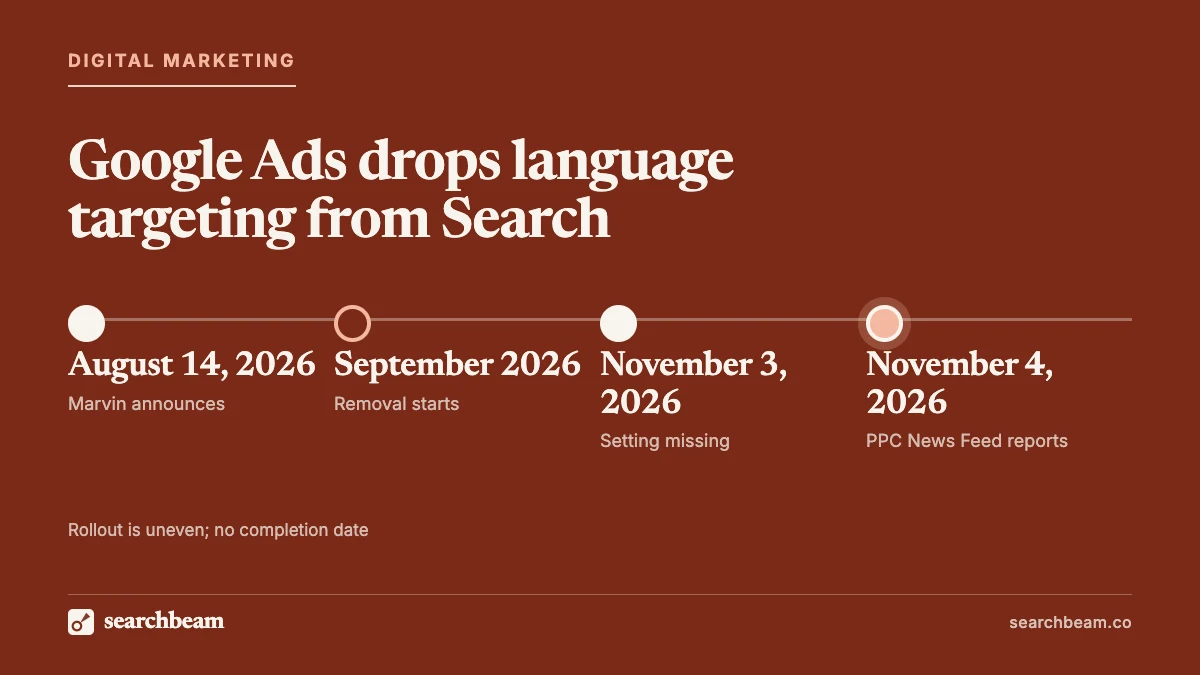
Google Ads has removed the campaign-level language setting from Search campaigns, and it no longer applies to the Search Network part of Performance Max. Ad language now matches users, so ad copy and landing pages act as the targeting control.
- The language setting is gone from Search campaigns in some live accounts; Google has given no completion date.
- Ad copy and landing page language now act as targeting signals, so mixed-language ad groups become a risk.
- Audit multilingual campaigns, keep one language per ad group, and check Google Ads Editor behavior.
Ask your own AI: ChatGPT Perplexity Claude AI Mode
On this page
Google Ads has removed the campaign-level language targeting setting from Search campaigns. As reported by PPC Land, practitioner Thomas Eccel flagged the missing control in a live account on November 3, 2026. Search ads now match users by the language of the ads themselves.
Did Google Ads remove language targeting from Search?
Yes, but the rollout looks uneven. PPC Land reports that Eccel’s account lost the setting, while another advertiser said it had not reached their accounts yet. One commenter said it was still visible in Google Ads Editor.
- Google’s documentation says Search ads will automatically match based on the language of your ads.
- In Performance Max, the setting no longer governs the Google Search Network, but still applies to YouTube, Display, Discover and Gmail. Shopping ads are not affected.
- Google announced a September 2026 start on August 14, 2026, after missing an end-of-2025 target. Its help page gives no completion date and says no action is required.
Why does Google Ads language targeting removal matter?
Because the language of your creative is now your targeting. A French headline or a German landing page is a signal Google reads, alongside the search term language and the user’s own language settings. Content decisions that used to be neutral now shape who sees the ad.
The biggest exposure is for accounts where country and language do not line up: multilingual markets, hotels and travel brands reaching visitors, and campaigns aimed at expatriates. PPC Land’s commenters raised open questions that Google’s text does not answer, such as ads with branded terms in another language, or a Japan-targeted hotel with only English and German landing pages. Treat those as unresolved, not as known behavior.
It also continues a broader shift of controls into Google’s systems, like the end of the hidden Display budget split for Search we covered earlier. Less manual control means the inputs you do control, creative and landing pages, matter more.
How to prepare your campaigns for the language change
Start by checking where your language setting did real work. Eccel and PPC News Feed recommend practices below; they are practitioner advice, not Google guidance, and Google says existing single-language structures keep working.
- List Search and Performance Max campaigns that relied on a language different from the country’s main one.
- Keep one language per ad group, and keep ad copy and the landing page in the same language.
- Keep separate campaigns per language for budget control and reporting, not for targeting.
- Review ads that mix languages, such as borrowed English terms, and watch impressions by query language.
- For Performance Max, expect the language setting to cover only non-Search channels, and compare channel-level reporting.
- Test what Google Ads Editor does with a language selection, since neither Google nor the reports explain it.
Follow more Google Ads changes in our Digital Marketing coverage.